
Program Information
Learn more about the Music Performance program.
Course Sequence
- Jump to the Course Sequence
- Print Course Sequence
Field of Interest

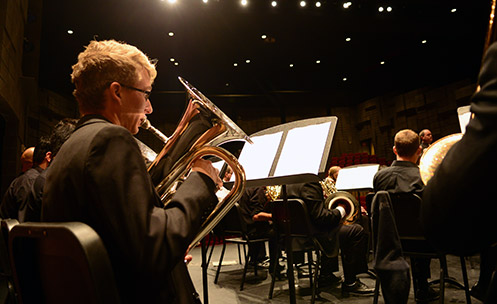
The Associate in Arts, Fine Arts (AAFA), Emphasis in Music degree is designed for students planning to transfer to four-year colleges and universities with majors in the Fine/Performing Arts. The degree is designed to prepare students to meet selective admission criteria for programs, such as the Bachelor of Music, which may require an audition. Embedded areas of emphasis include choral, instrumental, guitar and popular music performance.
Details
Important information you’ll need when applying for admission:
- Field of Interest
- Visual and Performing Arts
- Type
- Associate in Arts, Fine Arts (AAFA)
- Academic Plan
- Associate in Arts, Fine Arts, Emphasis in Music (DEG)
- Academic Plan Code
- 8313
- Total Credits Required
- 60-64
- Catalog Year
- 2026-2027
- Notes
Students must earn a grade of C or better in all courses within the program.
++ indicates that any suffixed course may be selected.In most cases, courses used to satisfy the AAFA, Emphasis in Music will apply to general university graduation requirements of related majors; however, students need to be aware of any specific lower division requirements of their intended focus at the university to be sure they select courses that will meet those requirements.
Some courses may require permission of instructor and/or audition for placement.
What You’ll Learn
This pathway map will help you gain the expertise needed to:
- Critically analyze music according to historical, cultural, and stylistic contexts in order to understand how musical composition changes over time and how it impacts current practice both in music creation and performance.
- Perform with an appropriate tone quality, pitch, rhythm, expression, and articulation/diction in a historically and stylistically informed manner.
- Use self-evaluation, critical feedback, and aural diagnosis to improve personal performance and instruction and that of others in both solo and group settings.
- Demonstrate an ability to use self-management and self-discipline to align personal choices and behaviors with the achievement of personal goals in the field of music.
- Demonstrate accountability and professionalism to prepare for further study in music.
- Communicate effectively in verbal, written, nonverbal, and expressive forms to musicians and laypersons.
- Collaborate with a diverse group of individuals to rehearse, perform, create, and instruct.
- Utilize technology to support composition, performance, instruction, and general communication.
- Explain how music reflects, shapes, creates, and disseminates culture.
- Locate and evaluate multiple sources of information to inform performance from varied historical contexts and genres.
Career Opportunities
Successful completion of this degree may lead to employment in a variety of different occupations and industries. Below are examples of related occupations with associated Maricopa County-based annual median wages* for this degree. Education requirements vary for the occupations listed below, so you may need further education or degrees in order to qualify for some of these jobs and earn the related salaries. Please visit with an academic advisor and/or program director for additional information. You can click on any occupation to view the detail regarding education level, wages, and employment information.
Course Sequence by Term
The following is the suggested course sequence by term. Please keep in mind:
- Students should meet with an academic advisor to develop an individual education plan that meets their academic and career goals. Use the Degree Progress Report Tool in your Student Center to manage your plan.
- The course sequence is laid out by suggested term and may be affected when students enter the program at different times of the year.
- Initial course placement is determined by current district placement measures and/or completion of 100-200 level course and/or program requirements.
- Degree and transfer seeking students may be required to successfully complete a MCCCD First Year Experience Course (FYE) within the first two semesters at a MCCCD College. Courses include FYE101 and FYE103. Course offerings will vary by college. See an academic, program, or faculty advisor for details.
Full-time Sequence
Full-time status is 12 credits to 18 credits per semester.
| Arizona General Education Curriculum (AGEC) |
|---|
|
Students pursuing an Associate for transfer to a university or a MCCCD bachelor's degree should note the following changes to the Arizona General Education Curriculum (AGEC) requirements, effective Catalog Years 2026-27 and beyond. Students are strongly encouraged to visit with an academic advisor to assess whether transitioning to the Reimagined AGEC requirements aligns with educational goals and to ensure completion of all graduation requirements. Effective Catalog Year 2026-27 and beyond, AGEC Requirements will include:
Effective Catalog Year 2026-27 and beyond, AGEC Requirements will no longer include:
For a full outline of the Reimagined AGEC Requirements, please visit Maricopa’s AGEC Webpage. |
Note: Because you are viewing this pathway map on a mobile device, some columns below have been hidden. To view all columns, please rotate your device or view this page on a device with a larger screen.
Term 1
| Course Number | Course Name | Requisites | Notes | Area | Credits |
|---|---|---|---|---|---|
| ENG101 or ENG107 |
First-Year Composition or First-Year Composition for ESL | Critical course | FYC, WCM or FYC, WCM | 3 | |
| MTC105 | Music Theory/Aural Perception I | Critical course Gateway course | 3 | ||
| AHM and MHL+++ |
Arts and Humanities and Any approved MHL Music: History/Literature course | Any approved MHL Music: History/Literature course in the Arts and Humanities [AHM] area. To be selected in consultation with an academic, faculty, or program advisor. | AHM | 3 | |
| FYE101 or FYE103 |
Introduction to College, Career and Personal Success or Exploration of College, Career and Personal Success | 1–3 | |||
| Plan Elective | Plan Course Elective | 2–6 |
Term 2
| Course Number | Course Name | Requisites | Notes | Area | Credits |
|---|---|---|---|---|---|
| ENG102 or ENG108 |
First-Year Composition or First-Year Composition for ESL | FYC, WCM or FYC, WCM | 3 | ||
| MTC155 | Music Theory/Aural Perception II | 3 | |||
| OCM | Oral Communication | OCM | 3 | ||
| SCB | Social and Behavioral Sciences | SCB | 3 | ||
| Plan Elective | Plan Course Elective | 2–6 |
Term 3
| Course Number | Course Name | Requisites | Notes | Area | Credits |
|---|---|---|---|---|---|
| MAT14+ | College Mathematics | OR Higher mathematical level Quantitative Reasoning [QNR] approved General Education course with a MAT prefix except MAT206. | QNR | 3–6 | |
| IAM | Institutions of the Americas | IAM | 3 | ||
| NSI | Natural Sciences | NSI | 4 | ||
| Plan Elective | Plan Course Elective | 2–6 |
Term 4
| Course Number | Course Name | Requisites | Notes | Area | Credits |
|---|---|---|---|---|---|
| AHM and MHL+++ |
Arts and Humanities and Any approved MHL Music: History/Literature course | AHM | 3 | ||
| NSI | Natural Sciences | NSI | 4 | ||
| SCB | Social and Behavioral Sciences | SCB | 3 | ||
| Plan Elective | Plan Course Elective | 2–6 |
General Electives
Select additional courses 100-level or higher to complete a minimum of 60 semester credits but no more than a total of 64 semester credits. Consult with a faculty advisor, program director, and/or academic advisor to identify coursework that best aligns with academic and professional goals.
Request Information
There’s a Better Way to Do College
We offer more value, opportunity, and support for our students. Connect with us to get information about the Associate in Arts, Fine Arts, Emphasis in Music Associate Degree; including resources, scholarships, and related programs.
Ready to get started?
Follow one of the options below to get started on your personal career pathway.
Become a Student
Click here for MCC’s easy-to-use Enrollment Steps.
Program Information
Learn more about and find contact information for the Music Performance program.
Course Area Key
Gateway Course = Generally the first major-specific course in a pathway.
Critical Course = A course that is highly predictive of future success in a pathway.
- AHM = Arts and Humanities
- CS = Computer/Statistics/Quantitative Application
- FYC = First-Year Composition
- IAM = Institutions of the Americas
- NSI = Natural Sciences
- OCM = Oral Communication
- QNR = Quantitative Reasoning
- SCB = Social and Behavioral Sciences
- WCM = Written Communication
Disclaimer
Students must earn a grade of C or better for all courses required within the program.
Course Sequence total credits may differ from the program information located on the MCCCD curriculum website due to program and system design.
At Maricopa, we strive to provide you with accurate and current information about our degree and certificate offerings. Due to the dynamic nature of the curriculum process, course and program information is subject to change. As a result, the course list associated with this degree or certificate on this site does not represent a contract, nor does it guarantee course availability. If you are interested in pursuing this degree or certificate, meet with an academic advisor to discuss the requirements at your college for the appropriate catalog year.
View MCCCD’s official curriculum documentation for additional details regarding the requirements of this award at https://aztransmac2.asu.edu/cgi-bin/WebObjects/acres.woa/wa/customView?id=16462109.
Previous Catalog Years
The pathway map presented above is for the current catalog year and is the intended pathway map for new students. All previous catalog years for this pathway map are available at the link below.