Field of Interest
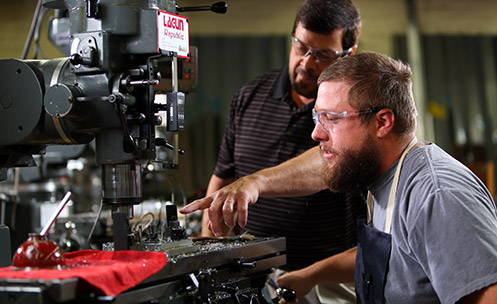
The Certificate of Completion (CCL) in CNC Machining I prepares students for employment as entry-level operators and technicians in the manufacturing industry. The program provides applied skills in process planning, quality control, set-up and operation of manual/Computer Numeric Control (CNC) machines for current and future needs of the manufacturing industry. This program introduces students to manual data programming and Computer-Aided Design/Computer-Aided Manufacturing (CAD/CAM). A CCL in CNC Machining II and an Associate in Applied Science (AAS) in Manufacturing Production Technology are also available.
Details
Important information you’ll need when applying for admission:
- Field of Interest
- Applied Technology
- Type
- Certificate of Completion (CCL)
- Academic Plan
- CNC Machining I (CER)
- Academic Plan Code
- 5100
- Total Credits Required
- 25
- Catalog Year
- 2025-2026
- Effective Term
- Spring 2024
- Notes
Students must earn a grade of C or better in all courses within the program.
This program replaces:
CCL/5440 Production Technology: CNC Technology
CCL/5616 CNC Machining I
What You’ll Learn
This pathway map will help you gain the expertise needed to:
- Practice safety rules and regulations applicable to a manufacturing environment.
- Use mathematical skills to solve basic manufacturing problems.
- Interpret technical documentation and materials to make informed decisions in manufacturing processes.
- Evaluate compliance using standardized industry inspection techniques.
- Demonstrate personal and professional accountability.
- Effectively communicate orally, visually, and in writing in the manufacturing environment.
- Effectively work within a team structure.
- Use the appropriate hand, measuring and cutting tool for a given task according to industry standards.
- Set up and operate manual machining equipment.
- Program, set up, and operate multi-axis Computer Numerical Control (CNC) manufacturing machinery or equipment using a combination of materials and technologies.
- Recognize manufacturing defects and make appropriate decisions.
Career Opportunities
Successful completion of this certificate may lead to
employment in a variety of different occupations and industries. Below are examples of related
occupations with associated Maricopa County-based annual median wages* for
this certificate. Education requirements vary for the
occupations listed below, so you may need further education or degrees in order to qualify for some
of these jobs and earn the related salaries. Please visit with an academic advisor and/or program
director for additional information. You can click on any occupation to view the detail regarding
education level, wages, and employment information.
Set up, operate, or tend lathe and turning machines to turn, bore, thread, form, or face metal or plastic materials, such as wire, rod, or bar stock.
Typical Education Level
a high school diploma or less
Hourly Median Wage
$27.04
Annual Median Wage
$56,253
Number of People Employed
216
4-Year Employment Growth
Increase
by 5.1 %
Set up, test, and adjust manufacturing machinery or equipment, using any combination of electrical, electronic, mechanical, hydraulic, pneumatic, or computer technologies.
Typical Education Level
a high school diploma or less
Hourly Median Wage
$22.61
Annual Median Wage
$47,033
Number of People Employed
1,182
4-Year Employment Growth
Increase
by 9.2 %
Set up, operate, or tend milling or planing machines to mill, plane, shape, groove, or profile metal or plastic work pieces.
Typical Education Level
a high school diploma or less
Hourly Median Wage
$31.68
Annual Median Wage
$65,906
Number of People Employed
82
4-Year Employment Growth
Increase
by 12.2 %
Set up, operate, or tend more than one type of cutting or forming machine tool or robot.
Typical Education Level
a high school diploma or less
Hourly Median Wage
$19.48
Annual Median Wage
$40,538
Number of People Employed
1,051
4-Year Employment Growth
Increase
by 11.0 %
* Career and wage information provided by Lightcast using data,
reports, and forecasts which are generated using government data sources and Lightcast’s
proprietary analytical processes. Lightcast’s data covers multiple classes of workers
including QCEW, non-QCEW, and those who are self-employed. Disclaimer
Course Sequence by Term
The following is the suggested course sequence by term. Please keep in mind:
- Students should meet with an academic advisor to develop an individual education plan that meets their academic and career goals. Use the Degree Progress Report Tool in your Student Center to manage your plan.
- The course sequence is laid out by suggested term and may be affected when students enter the program at different times of the year.
- Initial course placement is determined by current district placement measures and/or completion of 100-200 level course and/or program requirements.
- Degree and transfer seeking students may be required to successfully complete a MCCCD First Year Experience Course (FYE) within the first two semesters at a MCCCD College. Courses include FYE101 and FYE103. Course offerings will vary by college. See an academic, program, or faculty advisor for details.
Pathway Map Options
There are multiple options available for this pathway map.
These options vary depending on the locations, partners, and available tracks of the award.
These pathway map options may share some common coursework. To explore what additional coursework
may be required, select your desired option from the list below. Once selected, the list of
courses and any associated details will be automatically updated in the course sequence below.
The differences between individual pathway map options may only be a few courses.
Note: You will have to select one of the options below to view available
course sequences.
The list of courses below has been updated
To view course sequences, select one of the
pathway map options above.
Full-time status is 12 credits to 18 credits per semester.
Note: Because you are viewing this pathway map on a mobile device,
some columns below have been hidden. To view all columns, please rotate your device or view this
page on a device with a larger screen.
A sequence of suggested courses that should be taken during Fall Semester (Term 1)
Term 1
| Course Number |
Course Name |
Requisites |
Notes |
Area |
Credits |
| MPT101 |
Technical Documentation |
|
Critical course
First 8 weeks of term.
|
|
3 |
| MPT110 |
Inspection Techniques |
|
Critical course
Gateway course
First 8 weeks of term.
|
|
3 |
| MPT111 |
Geometric Dimensioning and Tolerance (GDT) |
|
Second 8 weeks of term.
|
|
3 |
| MPT120 |
Introduction to Manual Machining |
Prerequisites or Corequisites: (MPT101 or MPT101MP) and (MPT111 or MPT111MP), or permission of Program Director. |
Second 8 weeks of term.
|
|
4 |
| MPT101MP |
Technical Documentation |
|
Critical course
|
|
3 |
| MPT110MP |
Inspection Techniques |
|
Critical course
Gateway course
|
|
3 |
| MPT120MP |
Introduction to Manual Machining |
Prerequisites or Corequisites: (MPT101 or MPT101MP) and (MPT111 or MPT111MP), or permission of Program Director. |
|
|
4 |
| MPT111MP |
Geometric Dimensioning and Tolerance (GDT) |
|
|
|
3 |
A sequence of suggested courses that should be taken during Spring Semester (Term 2)
Term 2
| Course Number |
Course Name |
Requisites |
Notes |
Area |
Credits |
MPT130 or MPT131 |
CNC Machine Operator or CNC Machining Level I |
No requisites or Prerequisites: A grade of C or better in MPT120, or MPT120MP, or permission of Program Director. |
First 8 weeks of term.
|
|
6 |
| MPT132 |
CNC Machining Level II |
|
Second 8 weeks of term.
|
|
3 |
| MPT113 |
Coordinate Measuring Machines I |
Prerequisites: A grade of C or better in (MPT101 or MPT101MP) and (MPT110 or MPT110MP), or permission of Program Director. |
Second 8 weeks of term.
|
|
3 |
MPT130MP or MPT131MP |
CNC Machine Operator or CNC Machining Level I |
|
|
|
6 |
| MPT140 |
Manual CNC Programming |
Prerequisites: A grade of C or better in (MPT130 or MPT130MP) or (MPT131 or MPT131MP), or machine shop experience or permission of Program Director. |
|
|
3 |
To view course sequences, select one of the
pathway map options above.
Part-time status is 11 credit hours or less.
Note: Because you are viewing this pathway map on a mobile device,
some columns below have been hidden. To view all columns, please rotate your device or view this
page on a device with a larger screen.
A sequence of suggested courses that should be taken during Fall Semester (Term 1)
Term 1
| Course Number |
Course Name |
Requisites |
Notes |
Area |
Credits |
| MPT101 |
Technical Documentation |
|
Critical course
First 8 weeks of term.
|
|
3 |
| MPT101MP |
Technical Documentation |
|
Critical course
|
|
3 |
| MPT110MP |
Inspection Techniques |
|
Critical course
Gateway course
|
|
3 |
A sequence of suggested courses that should be taken during Spring Semester (Term 2)
Term 2
| Course Number |
Course Name |
Requisites |
Notes |
Area |
Credits |
| MPT110 |
Inspection Techniques |
|
Critical course
Gateway course
First 8 weeks of term.
|
|
3 |
| MPT111 |
Geometric Dimensioning and Tolerance (GDT) |
|
Second 8 weeks of term.
|
|
3 |
| MPT111MP |
Geometric Dimensioning and Tolerance (GDT) |
|
|
|
3 |
A sequence of suggested courses that should be taken during Fall Semester (Term 3)
Term 3
| Course Number |
Course Name |
Requisites |
Notes |
Area |
Credits |
| MPT120 |
Introduction to Manual Machining |
Prerequisites or Corequisites: (MPT101 or MPT101MP) and (MPT111 or MPT111MP), or permission of Program Director. |
Second 8 weeks of term.
|
|
4 |
| MPT120MP |
Introduction to Manual Machining |
Prerequisites or Corequisites: (MPT101 or MPT101MP) and (MPT111 or MPT111MP), or permission of Program Director. |
|
|
4 |
A sequence of suggested courses that should be taken during Spring Semester (Term 4)
Term 4
| Course Number |
Course Name |
Requisites |
Notes |
Area |
Credits |
MPT130 or MPT131 |
CNC Machine Operator or CNC Machining Level I |
No requisites or Prerequisites: A grade of C or better in MPT120, or MPT120MP, or permission of Program Director. |
First 8 weeks of term.
|
|
6 |
MPT130MP or MPT131MP |
CNC Machine Operator or CNC Machining Level I |
|
|
|
6 |
| MPT140 |
Manual CNC Programming |
Prerequisites: A grade of C or better in (MPT130 or MPT130MP) or (MPT131 or MPT131MP), or machine shop experience or permission of Program Director. |
|
|
3 |
A sequence of suggested courses that should be taken during Fall Semester (Term 5)
Term 5
| Course Number |
Course Name |
Requisites |
Notes |
Area |
Credits |
| MPT132 |
CNC Machining Level II |
|
Second 8 weeks of term.
|
|
3 |
| MPT132MP |
CNC Machining Level II |
Prerequisites: A grade of C or better in MPT130, or MPT130MP, or MPT131, or MPT131MP, or permission of Program Director. |
|
|
3 |
A sequence of suggested courses that should be taken during Spring Semester (Term 6)
| Course Number |
Course Name |
Requisites |
Notes |
Area |
Credits |
| MPT113 |
Coordinate Measuring Machines I |
Prerequisites: A grade of C or better in (MPT101 or MPT101MP) and (MPT110 or MPT110MP), or permission of Program Director. |
Second 8 weeks of term.
|
|
3 |
Pathway Map Option Details
No pathway map option has been selected. Please select from the pathway
map options listed above.
Ready to get started?
Follow one of the options below to get started on your personal career pathway.
Click here for MCC’s easy-to-use Enrollment Steps.
Learn more about and find contact information for the Manufacturing program.
Ask general questions over the phone at 480-461-7400 or via online chat.
Course Area Key
Gateway Course = Generally the first major-specific course in a pathway.
Critical Course = A course that is highly predictive of future success in a pathway.
Disclaimer
Course Sequence total credits may differ from the program information located on the MCCCD curriculum website due to program and system design.
At Maricopa, we strive to provide you with accurate and current information about our degree and certificate offerings. Due to the dynamic nature of the curriculum process, course and program information is subject to change. As a result, the course list associated with this degree or certificate on this site does not represent a contract, nor does it guarantee course availability. If you are interested in pursuing this degree or certificate, meet with an academic advisor to discuss the requirements at your college for the appropriate catalog year.
View MCCCD’s official curriculum documentation for additional details regarding the requirements of this award (https://aztransmac2.asu.edu/cgi-bin/WebObjects/MCCCD.woa/wa/freeForm11?id=187888).
Previous Catalog Years
The pathway map presented above is for the current catalog year and is the intended pathway map for new students. All previous catalog years for this pathway map are available at the link below.
Previous catalog years for Certificate of Completion (CCL) in CNC Machining I