Field of Interest

Prepare for a future in science.
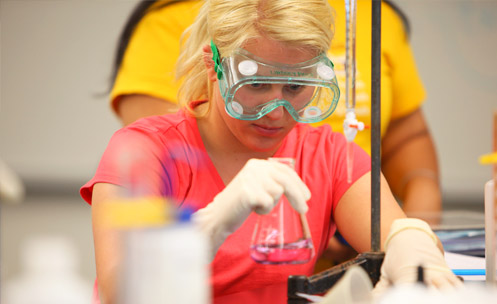
Learn the fundamental theories of chemistry in our hands-on program, where you will gain laboratory and safety protocol experience and learn how to make informed decisions while practicing ethical and social responsibility.
The Right Pathway for You
MCC offers options for your future. Your interests and goals will guide you in selecting the pathway for you to realize your dreams.
University Transfer Degree
Want to pursue a bachelor’s degree at a university? Save money by starting at MCC in manageable, small classes taught by renowned faculty. Our transfer pathways with Arizona universities help you achieve two goals: completing an associate’s degree while also staying on track to earn a bachelor’s degree at your transfer destination. MCC’s university partnerships throughout the nation assure your seamless transition toward a four-year degree.
A list of available transfer degrees offered in the Chemistry program
| Name |
Type |
Title |
Courses |
|
Associate in Science |
AS |
Associate in Science, Emphasis in Chemistry |
Pathway Map |
Career Opportunities
Successful completion of a degree within the Chemistry program may lead to employment in a variety of different occupations and industries. Below are examples of related occupations with associated Maricopa County-based annual median wages*. Some occupations may require additional education or training. You can click on any occupation to view more detail regarding education level, wages, and employment information.
Design chemical plant equipment and devise processes for manufacturing chemicals and products, such as gasoline, synthetic rubber, plastics, detergents, cement, paper, and pulp, by applying principles and technology of chemistry, physics, and engineering.
Typical Education Level
a Bachelor's degree
Hourly Median Wage
$69.94
Annual Median Wage
$145,480
Number of People Employed
100
4-Year Employment Growth
Increase by 18.0%
Operate or tend equipment to control chemical changes or reactions in the processing of industrial or consumer products. Equipment used includes devulcanizers, steam-jacketed kettles, and reactor vessels.
Typical Education Level
a high school diploma or less
Hourly Median Wage
$22.24
Annual Median Wage
$46,275
Number of People Employed
1,036
4-Year Employment Growth
Increase by 16.0%
Conduct chemical and physical laboratory tests to assist scientists in making qualitative and quantitative analyses of solids, liquids, and gaseous materials for research and development of new products or processes, quality control, maintenance of environmental standards, and other work involving experimental, theoretical, or practical application of chemistry and related sciences.
Typical Education Level
a Bachelor's degree
Hourly Median Wage
$30.76
Annual Median Wage
$63,983
Number of People Employed
266
4-Year Employment Growth
Increase by 15.0%
Conduct qualitative and quantitative chemical analyses or experiments in laboratories for quality or process control or to develop new products or knowledge.
Typical Education Level
a Bachelor's degree
Hourly Median Wage
$38.11
Annual Median Wage
$79,284
Number of People Employed
582
4-Year Employment Growth
Increase by 13.4%
Research and study the structures and chemical properties of various natural and synthetic or composite materials, including metals, alloys, rubber, ceramics, semiconductors, polymers, and glass. Determine ways to strengthen or combine materials or develop new materials with new or specific properties for use in a variety of products and applications. Includes glass scientists, ceramic scientists, metallurgical scientists, and polymer scientists.
Typical Education Level
a Bachelor's degree
Hourly Median Wage
$51.41
Annual Median Wage
$106,938
Number of People Employed
75
4-Year Employment Growth
Increase by 10.7%
Teach courses pertaining to the chemical and physical properties and compositional changes of substances. Work may include providing instruction in the methods of qualitative and quantitative chemical analysis. Includes both teachers primarily engaged in teaching, and those who do a combination of teaching and research.
Typical Education Level
a Doctoral degree or more
Hourly Median Wage
$37.29
Annual Median Wage
$77,583
Annual Job Openings
2,443
Number of People Employed
23,583
4-Year Employment Growth
Increase by 11.3%
* Career and wage information provided by Lightcast using data, reports, and forecasts which are generated using government data sources and Lightcast’s proprietary analytical processes. Lightcast’s data covers multiple classes of workers including QCEW, non-QCEW, and those who are self-employed. Disclaimer
Request Information
There’s a Better Way to Do College
We offer more value, opportunity, and support for our students. Connect with us to get information about all of our Chemistry offerings, including resources, scholarships, and related programs.