
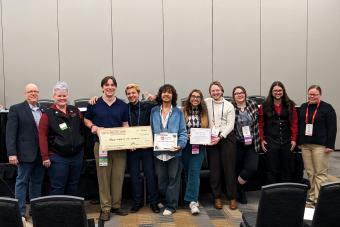
MESA, Ariz. -- April 14, 2025 -- Mesa Community College Theatre and Film Arts students earned the United States Institute for Theatre Technology (USITT) Director’s Award during the organization’s conference in March.
MCC Director of Performing Arts Facilities Chris Tubilewicz, served as faculty advisor for the seven-person MCC team: Sedrikk Cramer, Theodore Felix Grant McEntire, Jeffrey Rudolph, Sarah Salmi, Rodrigo Sandoval, Brian Wayne and Elizabeth Witte. American Society of Theatre Consultants (ASTC) member Kascey Haslanger served as the team’s mentor.
The MCC team is the first team from a two-year program to participate in the ASTC-USITT Venue Renovation Challenge. They competed against teams from Oberlin College and Conservatory, University of Oklahoma and The Ohio State University.
The MCC team developed a concept to transform an existing cineplex into Alice Cooper’s Solid Rock Teen Center Performance Venue. The nonprofit organization is in need of a performance venue to host existing programming. A dedicated building would provide additional revenue and opportunities for fundraising. The team incorporated visual aesthetics from Alice Cooper’s live shows into the interior design and layout of the building. [The team's full presentation is available on request.]
“It has been a wonderful experience mentoring this group through this process. The students who participated fearlessly dove into what was certainly new territory with focus and enthusiasm. Watching this team familiarize themselves with new skills and tools in a very short period of time toward the goal of completing this project was inspiring to say the least,” said Tubilewicz. “I for one am extremely proud of the work these students did and the fact that they won this award in MCC’s first time competing in this challenge is a testament to their quality.”
For the Challenge, participants representing a variety of academic backgrounds including theatre, architecture and engineering, work together to envision the renovation of an existing theatre space or adaptation of an existing building for performing arts programming. The teams are guided by faculty advisors and ASTC mentors, and presentations are judged by five ASTC members.
Students presented their design with materials including research of existing conditions and user-groups’ needs, sketches and renderings showing their design process, proposed plans and sections, and interior and exterior finishes. Howard Glickman, ASTC Chair of Outreach and Education, praised each of the teams for delivering thorough, professional-quality presentations.
USITT Education and Training Coordinator Andrea Ball presented the $1,000 USITT Director’s Award for showing special merit during a ceremony on March 7, 2025 in Columbus, Ohio.
# # #
Media contacts:
American Society of Theatre Consultants Peter Scheu, [email protected], 855-800-2782
Mesa Community College Dawn Zimmer, [email protected], 480-461-7892
United States Institute for Theatre Technology was founded in 1960 as an organization to promote dialogue, research, and learning among practitioners of theatre design and technology. Today it has grown to include members at all levels of their careers and has embraced the new technologies being used in entertainment. USITT is now the leader in life-long learning opportunities for the entertainment design and technology industry. More at usitt.org.
American Society of Theatre Consultants’ primary objective is to inform owners, users, and planners about the services that theatre consultants offer and about the value of those services to the achievement of effective and economically viable performance and assembly facilities, whether large or small, whether new construction or remodeling/renovation project. Members of the ASTC are professional theatre consultants who have demonstrated a broad range of capability and experience necessary to qualify for membership. As professionals, ASTC members have individual and collective interests in providing unbiased, functionally sound and practical consulting and design services to owners, users, architects, and engineers or performance and assembly facilities. These interests are reflected in the objectives and programs of the Society. Learn more: theatreconsultants.org.
Mesa Community College (MCC), which is celebrating its 60th anniversary during 2025, is nationally recognized for its excellence in university transfer, career and technical programs, civic engagement, and innovative education. Serving over 25,500 students annually, MCC offers a range of degree and certificate programs across its two campuses and additional locations. MCC students contribute more than 8,500 hours of community service annually. For nearly 60 years, MCC has been a key resource for education, workforce development, and lifelong learning. The college enhances student success through Guided Pathways with Integrated Support Services. A Hispanic Serving Institution, nearly 50% of MCC students are first-generation college attendees, and it boasts the largest indigenous student population among Maricopa County Community College District (MCCCD) colleges. The MCC American Indian Institute supports students from 22 Arizona tribes and additional out-of-state tribes. MCC's diverse student body includes hundreds of international students. Our award-winning faculty are committed to helping students achieve their goals through high-quality education and training. Located in the East Valley of Phoenix, Arizona, on the traditional lands of the O'odham, Piipaash, and Yavapai Peoples, MCC is one of 10 MCCCD colleges. Learn more at mesacc.edu.
MCC is accredited by the Higher Learning Commission (HLC), hlcommission.org.
The Maricopa County Community College District (MCCCD) is an EEO/AA institution and an equal opportunity employer of protected veterans and individuals with disabilities. All qualified applicants will receive consideration for employment without regard to race, color, religion, sex, sexual orientation, gender identity, age, or national origin. A lack of English language skills will not be a barrier to admission and participation in the career and technical education programs of the District. MCCCD does not discriminate on the basis of race, color, national origin, sex, disability or age in its programs or activities. For Title IX/504 concerns, call the following number to reach the appointed coordinator: (480) 731-8499. For additional information, as well as a listing of all coordinators within the Maricopa College system, visit www.maricopa.edu/non-discrimination.