

Contact the Program Coordinator
Contact the Program Director
This program is part of the Applied Sciences and Technology Department.
Field of Interest

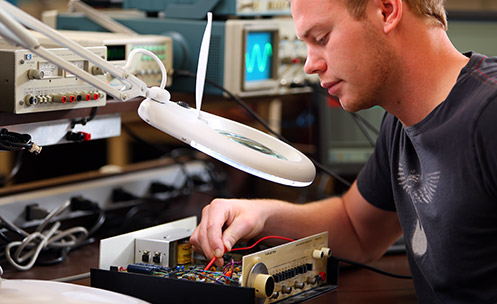
Start your career in electronics.
Imagine making a living from your fascination with gadgets! Our program can prepare you for a rewarding career working as an electronics technician, manufacturing supervisor, test equipment specialist, prototype fabricator, and more.
The Right Pathway for You
MCC offers Certificates of Completion and Associate Degrees for this program. Your interests and goals will guide you in selecting the pathway that is ideal for you. You may find a combination of certificates or degrees is the fastest way to realize your dreams.
Certificate
The knowledge and skills acquired while earning a Certificate of Completion (CCL) can help launch you into a new career or energize your current job. Generally requiring fewer credit hours than degrees or transfer programs, a CCL may be your best first step into higher education.
| Name | Type | Title | Courses |
|---|---|---|---|
| Certificate of Completion | CCL | Electronics Technology | Pathway Map |
Associate Degrees
MCC’s associate degrees enhance your resume and prepare you to enter the workforce with an advantage. Whether you are interested in simply completing basic, required college courses or specializing in a specific area, there’s a degree for you.
| Name | Type | Title | Courses |
|---|---|---|---|
| Associate in Applied Science | AAS | Electronics Engineering Technology | Pathway Map |
| Associate in Applied Science | AAS | Electronics Technology | Pathway Map |
Career Opportunities
Successful completion of a degree or certificate within the Electronics Technology program may lead to employment in a variety of different occupations and industries. Below are examples of related occupations with associated Maricopa County-based annual median wages*. Some occupations may require additional education or training. You can click on any occupation to view more detail regarding education level, wages, and employment information.
Financial Aid
You can get a high-quality, affordable education. MCC’s low tuition rates and various financial aid opportunities make it possible. Explore federal and state grants, Federal Work-Study, scholarships, student loans, and other options today.
Connect with an Advisor
Click here for MCC’s easy-to-use Enrollment Steps.
Before signing up for classes, you’ll want to connect with an academic advisor. Together, you’ll lay out an academic plan that suits you best. This step is essential to your academic success.
Resources For You
Get credit for your industry training. MCC offers Prior Learning Assessment (PLA) for students with existing industry certifications, licenses, and approved corporate training. Access the form below and attach proof of training/certification when you submit your request. Please note, in order to access and complete the PLA form, you must be an active MCC student and have an MEID.
Additional Resources