
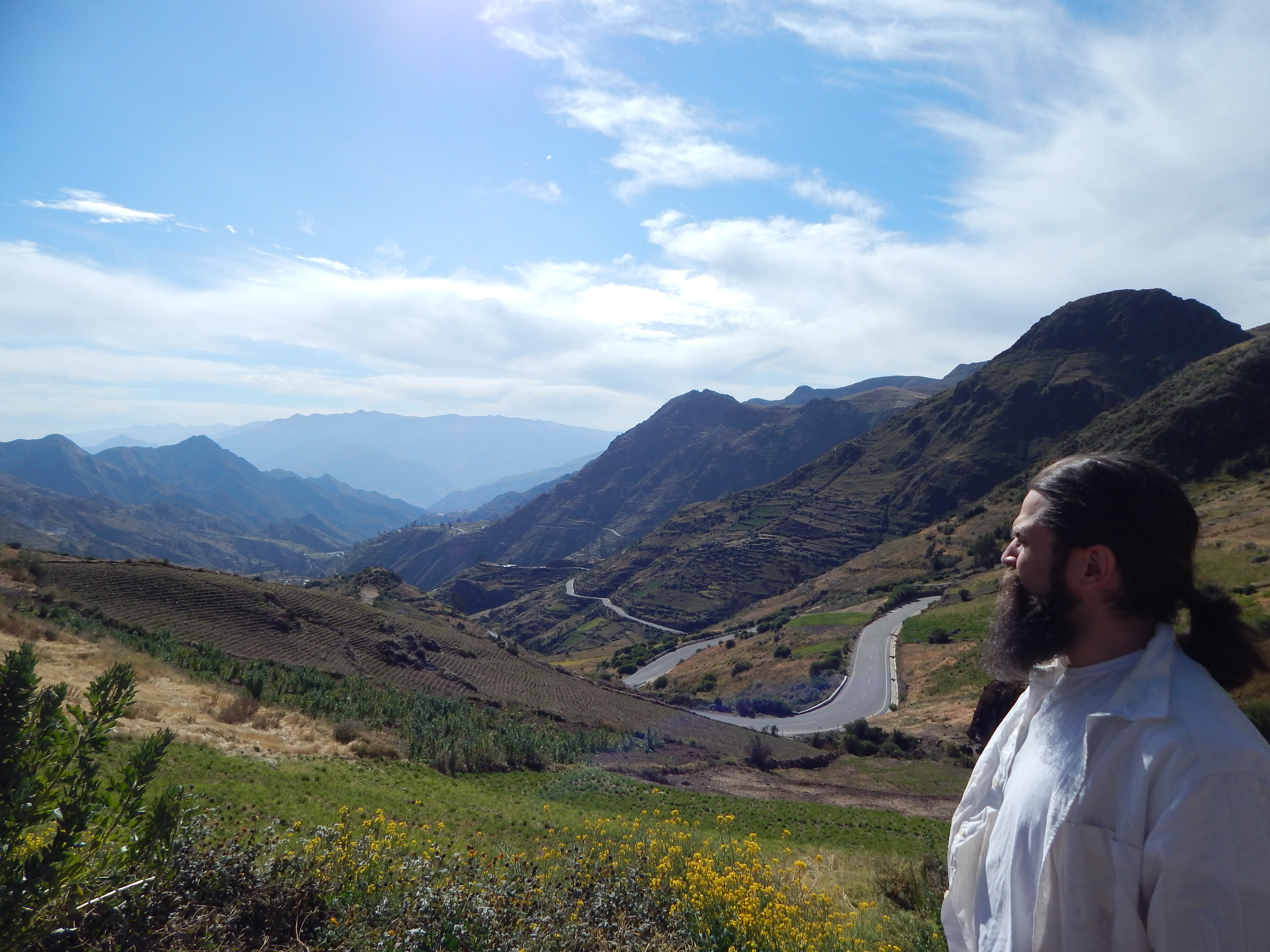
While earning an undergraduate degree in anthropology at the State University of New York–Buffalo, Mesa Community College Archeology faculty Kirk Costion, Ph.D., wasn’t planning on a teaching career. “It didn’t even cross my mind to be a college professor,” he admitted. “Growing up I wanted to be a pilot and attend the U.S. Air Force Academy.”
That career goal changed when he attended a summer archeology field school in Peru after his college sophomore year and got hooked for good. The immersive training program exposed him to real archeological methods like excavation, survey and artifact analysis. Before that impactful summer, Costion “took classes I thought would be fun and interesting but experiencing archeology first-hand became my lifelong passion.”
After earning his doctoral degree from the University of Pittsburgh, Costion went on to teach archeology and anthropology at the Oglala Lakota College on the Pine Ridge Indian Reservation in South Dakota for five years. He primarily taught general social science and statistics courses and occasionally anthropology and archeology classes but knew his ultimate goal was to run an archeology field school. So when a faculty position came up at MCC, which he discovered had such a school, he jumped at the opportunity. “That’s why I really like teaching here. It makes teaching more interesting for me.
“My favorite part of working with students is giving them the background, setting them free and watching them learn and improve their skills as they’re working at an archeological site rather than sitting in a classroom.” When they are in a classroom setting, Costion lectures in a conversational style to create a give-and-take with his students to peak their curiosity. Specializing in anthropological archeology, Costion teaches a variety of courses, the most popular being Buried Cities & Lost Tribes and Archeological Field Methods involving the excavation of local prehistoric sites.
The Mesa resident also collaborates with student volunteers on projects such as analyzing decorated ceramics and projectile points and the disposal patterns of domestic refuse and debris associated with ritual activities at early transitional Hohokam archeological sites around the Valley.
Costion may not have heard of MCC and its reputation for quality academics prior to applying for the job, but 11 years later he has contributed in a significant way to its prestigious standing. A popular faculty member with high student ratings, he is a respected local and national expert in the archeological field. A member-at-large of the Arizona Archeological Council, Costion is the co-editor of “Modeling Cross-Cultural Interaction in Ancient Borderlands”, a book published in 2018 to help researchers demonstrate complex webs of connections among people, landscapes and artifacts.
His early fascination with the ancient, Indigenous Huaracane settlement in the Moquegua Valley of Southern Peru led to a co-written article appearing in a recent issue of Latin American Antiquity, a distinguished quarterly journal published by the renowned Cambridge University Press of Cambridge, England. “It’s an important achievement because it is probably the most widely read academic archeology journal regionally focused on Latin America,” he added.
Conducting research in 2006 at the site at an elevation of more than 5,200 feet above sea level for his doctoral dissertation, Costion and his team discovered evidence pointing to the production of a traditional ancient beer, chicha de molle, brewed with Peruvian pink pepper berries by the Huaracane. But the finding has a twist: only the Wari Empire, another Indigenous group in the area, was typically known for the fermented brew used for rituals, celebrations and social bonding. “Our interpretation is that the Huaracane didn’t simply adopt a Wari practice but adapted it to fit in with their own cultural practices.”
An avid hiker who enjoys Arizona’s numerous trails and landmarks, Costion, like the Huaracane, is also a home brewer but unlike the Huaracane, he leaves out the Peruvian pink pepper berries.